
How to Register for Your CAIE Exams (Private Candidate Guide)
If you’re planning to take your Cambridge International (CAIE) exams privately, the process can feel a bit overwhelming at first. But don't worry! I’ve put together this step-by-step guide to help you navigate the British Council registration portal smoothly. Just follow along, and you’ll have your registration done in no time.
Step 1: Visit the British Council Portal
The very first thing you need to do is get to the right website. The British Council uses a specific system called the School Registration System (SRS) for all private candidates.
The Link: https://schoolexams.britishcouncil.org
Step 2: Create Your Account
Once you click the registration link, the very first thing you’ll need to do is set up your account. Think of this as creating your "Candidate Profile" this is where all your exam details and results will eventually live.
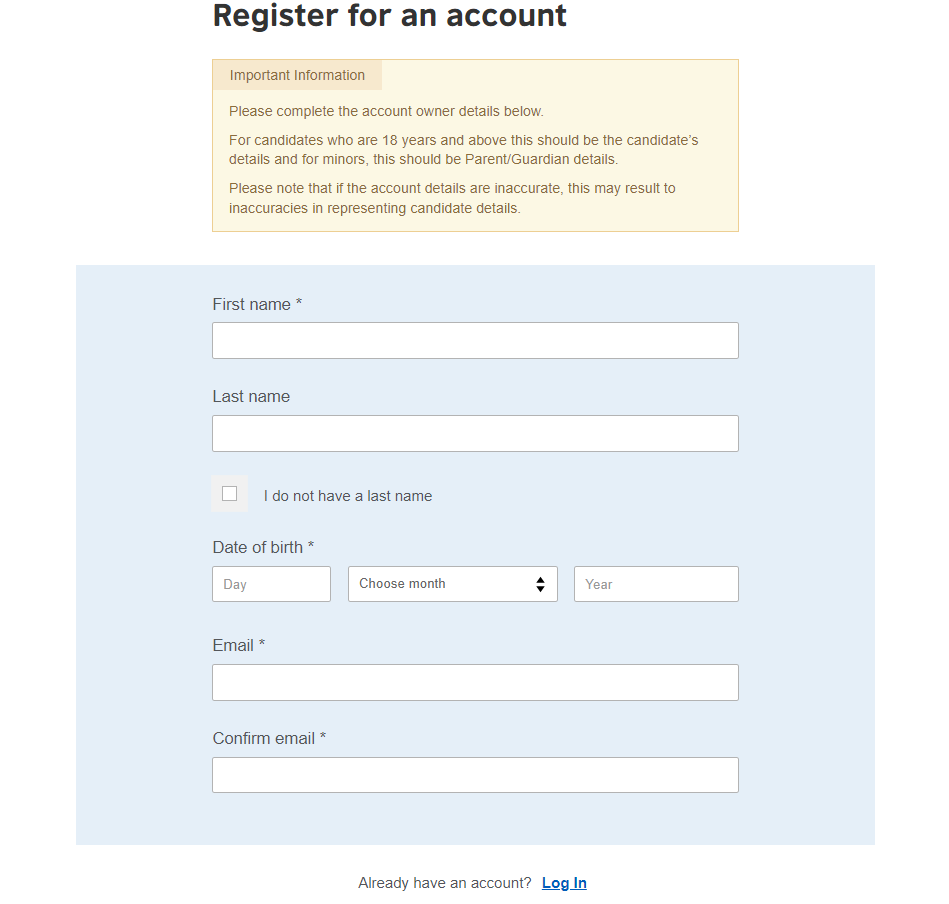
What you need to fill out:
First and Last Name: Make sure you enter your name exactly as it appears on your CNIC, Passport, or B-Form.
Date of Birth: Use the dropdowns to select your day, month, and year of birth.
Email Address: Use an email that you actually check regularly. The British Council will send your confirmation, venue details, and timetable here.
If you’ve registered for exams before you don’t need a new account. Just click the "Log In" link at the bottom of the page to skip this step.
Step 3: Activate Your Account and Log In
Once you’ve hit that register button, your account isn't quite "live" yet. The British Council needs to make sure your email address is real, so they’ll send you an activation link.
What you need to do:
Check your Inbox: Head over to your email. You should see a message from the British Council (if it’s not there, check your Junk or Spam folder it sometimes ends up there!).
Click the Activation Link: Inside that email, there will be a link to verify your account. Clicking this will officially activate your profile and redirect you back to the British Council website.
Log In: Now that you’re verified, enter the email address and password you just created.
Imp: If you don't receive the email within 10 minutes, try requesting a "Resend" on the website. Also, make sure you keep your password written down somewhere safe; you'll need it later to download your Statement of Entry and check your results!
Step 4: Selecting Your Location
After logging in, you’ll be greeted by the official British Council registration landing page. This is where the system tailors the experience to your specific region.
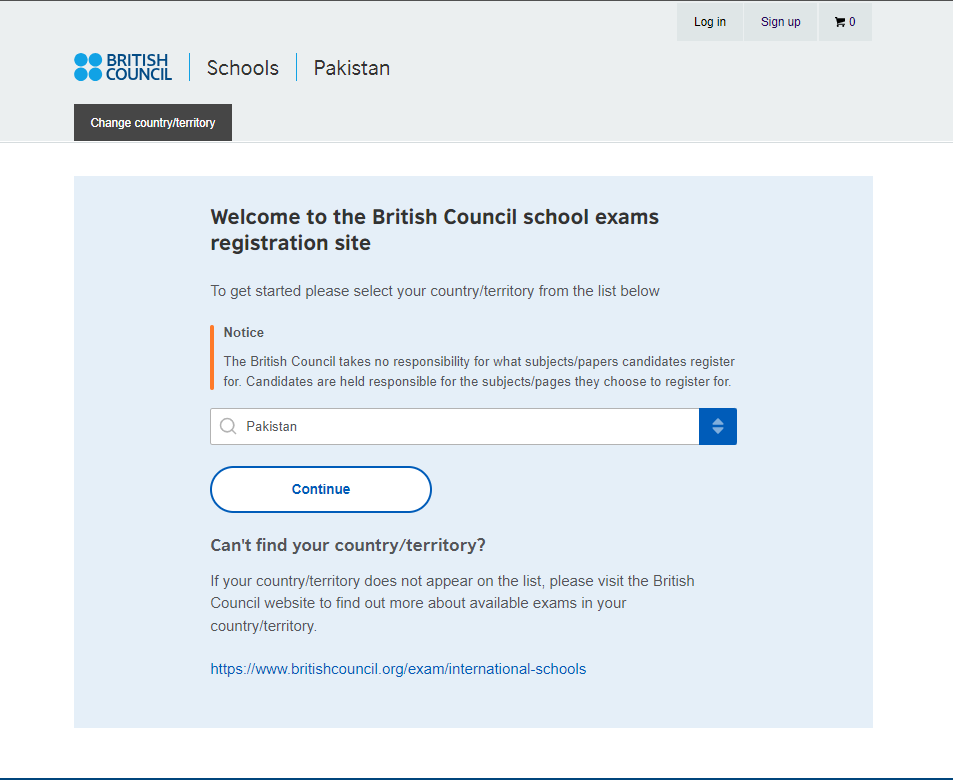
What to do on this screen:
Confirm Your Country: In the search box, you’ll see a list of countries. If you're registering from Pakistan (as seen in the example), make sure "Pakistan" is selected.
The "Notice" Box: You’ll see a small orange disclaimer. It’s basically reminding you that you are responsible for picking the right subjects and papers. The British Council won't double-check if you’ve picked the right syllabus code, so keep your school or private syllabus guide handy!
Click Continue: Once your country is set, hit that big blue Continue button.
Step 5: Choosing Your Awarding Body
Once you’re logged in and have your profile ready, you’ll land on the "Search for exams" page. This is the starting point for building your exam schedule.
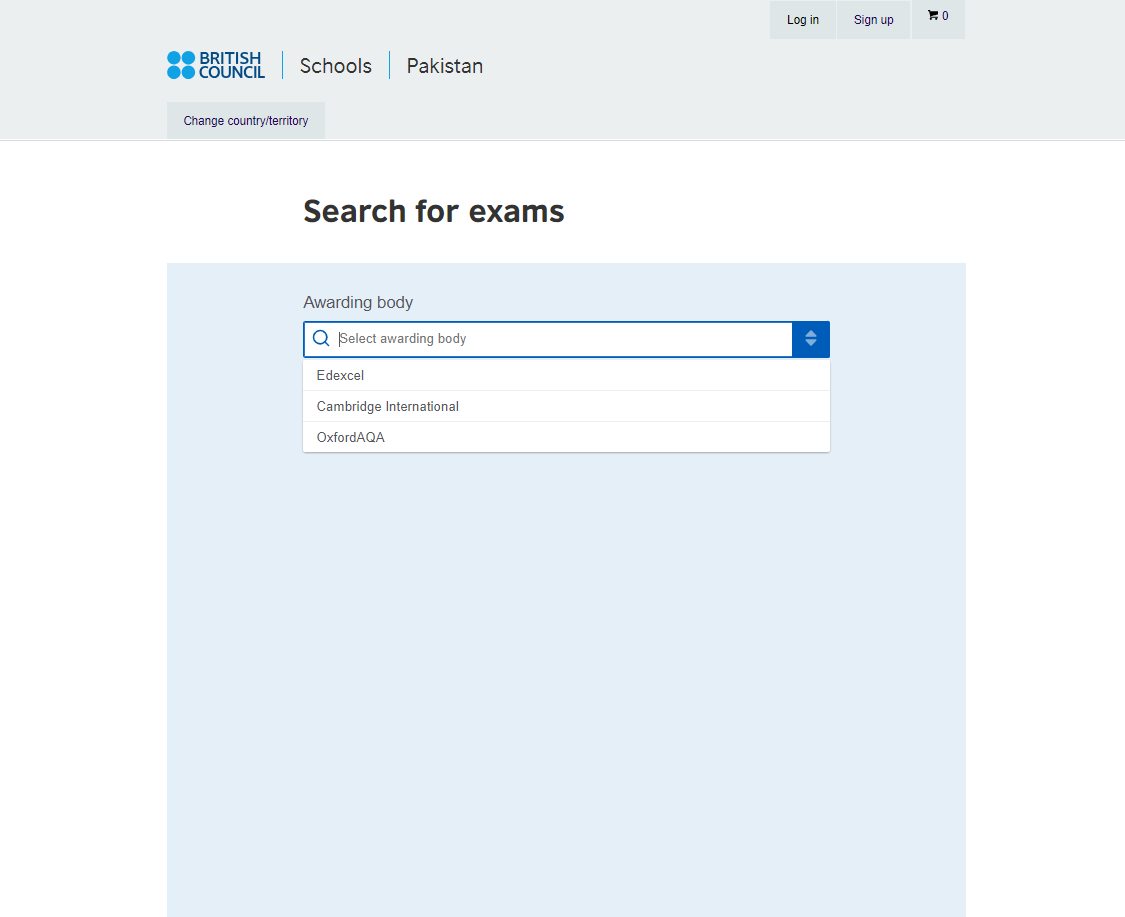
What to do on this screen:
On this page, you need to select the Awarding body. Since you are looking to register for Cambridge exams, you’ll see a few options in the dropdown menu:
Select "Cambridge International": From the list (which also includes Edexcel and OxfordAQA), make sure you click on Cambridge International.
Why this matters:
Each awarding body has different subject codes, exam dates, and fees. Choosing "Cambridge International" ensures you are looking at the correct IGCSE, O Level, or A Level syllabus that your school or self-study plan follows.
Step 6: Choosing Your Exam Session
Once you've selected "Cambridge International," a new dropdown menu will appear titled "Session." This is where you tell the British Council exactly which exam series you are aiming for.
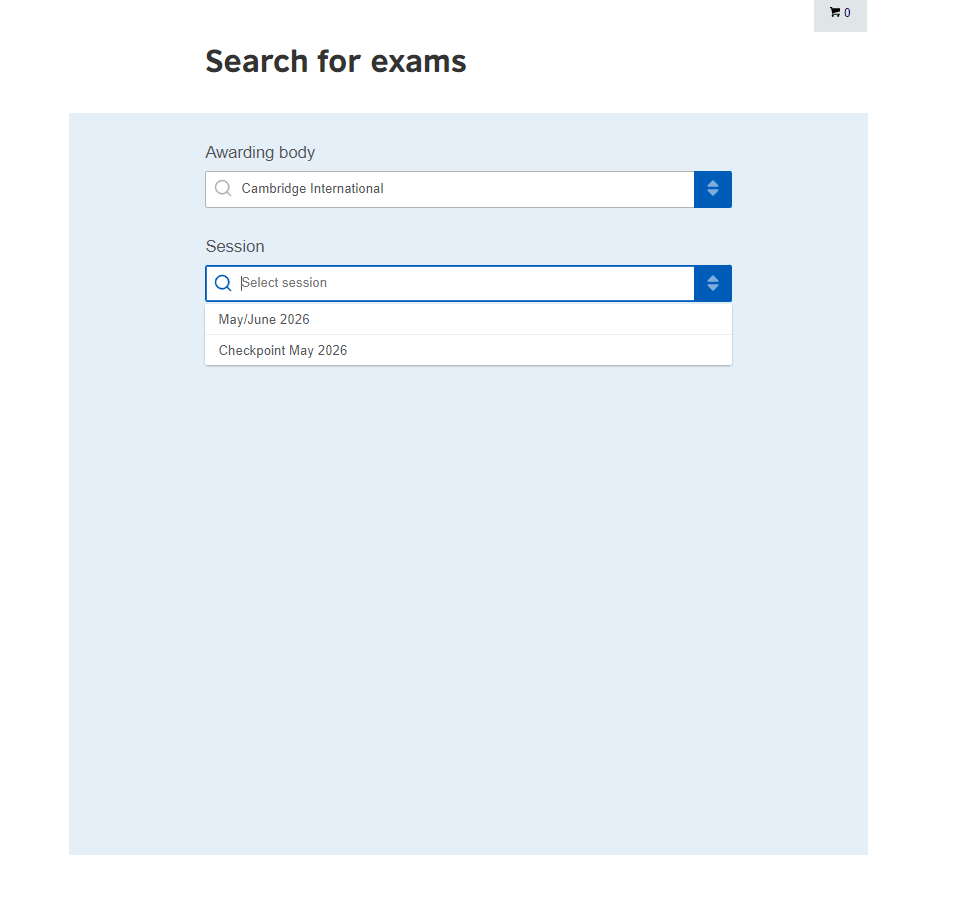
What to do on this screen:
Select the Session: Click on the "Select session" box. For most students, you’ll be looking for "May/June 2026" (or Checkpoint May) according tp your session.
Why is this important?
The British Council usually has two main sessions a year (May/June and Oct/Nov). Picking the wrong one here means you won't find the subjects you've been studying for! Double-check that the year and the months match your study plan.
A Quick Tip: If you don't see the session you're looking for, it might be because the registration deadline has passed or it hasn't opened yet. Always keep an eye on the British Council’s deadline calendar so you don't miss the "Normal Entry" fee period!
Step 7: Selecting Your Qualification Level
Once you’ve locked in the exam session (like May/June 2026), a new dropdown will appear called "Qualification level." This is where you filter the subjects to match your specific grade level.
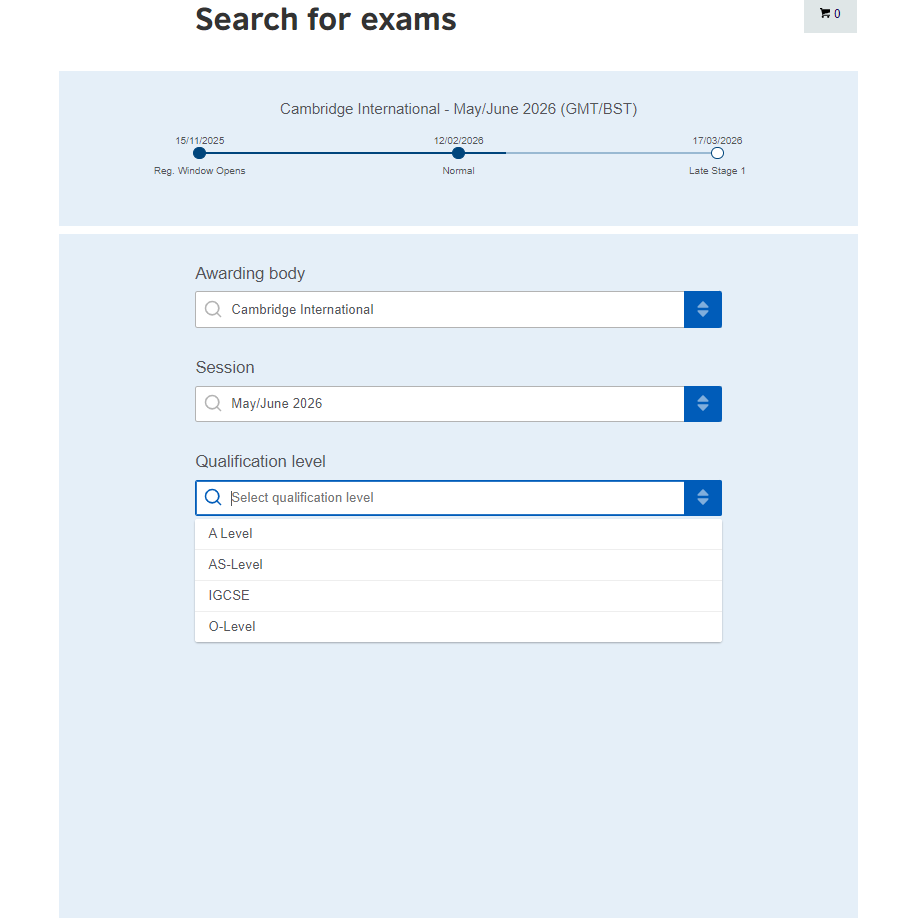
What to do on this screen:
Check the Timeline: At the top of the screen, you’ll see a blue progress bar. This is a lifesaver! It shows you exactly where you are in the registration window.
Normal: This means you are paying the standard price.
Late Stage 1: If the dot moves here, the British Council starts charging extra "late fees," so try to finish your registration while the dot is still in the "Normal" zone!
Pick your Qualification: Click the dropdown and select the level you are appearing for:
O-Level / IGCSE: Usually for students in Grade 10 or 11.
AS-Level: Typically the first year of A Levels.
A Level: The full qualification (often including A2).
Why this matters:
Many subjects (like Math or Physics) exist in both O-Level and IGCSE versions. By picking the right level here, you ensure the search results in the next step only show the subjects that actually apply to you.
Step 8: Choosing Your Exam Location
Now that the system knows what you are taking, it needs to know where you’ll be taking it. A new dropdown called "Location" will appear.
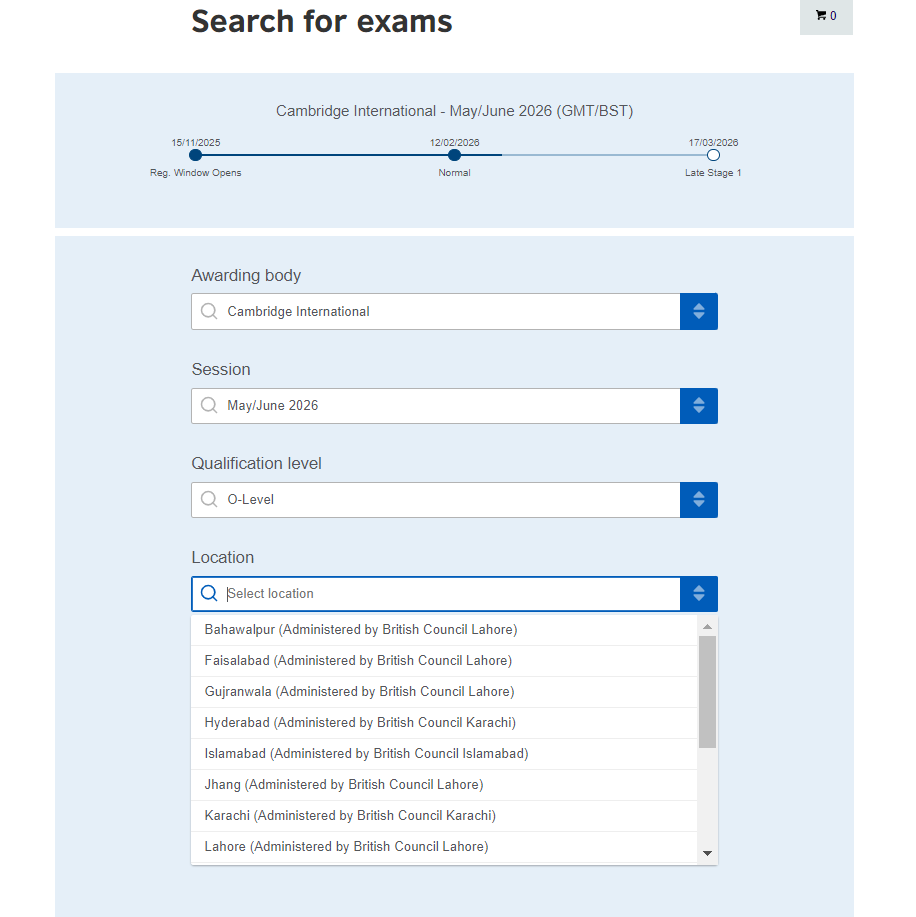
What to do on this screen:
Select Your City: Click the dropdown and find your city from the list. As you can see in the example, it lists cities like Islamabad, Karachi, Lahore, and Faisalabad.
Check the Administering Office: Next to your city, you’ll see which main British Council office is handling your area (e.g., "Administered by British Council Lahore"). This is just for your information so you know who to contact if you have local queries.
Step 9: Selecting Your Subjects
Once you’ve set your location (like Lahore or Karachi), the final dropdown menu for "Subjects" will appear. This is where you build your exam list.
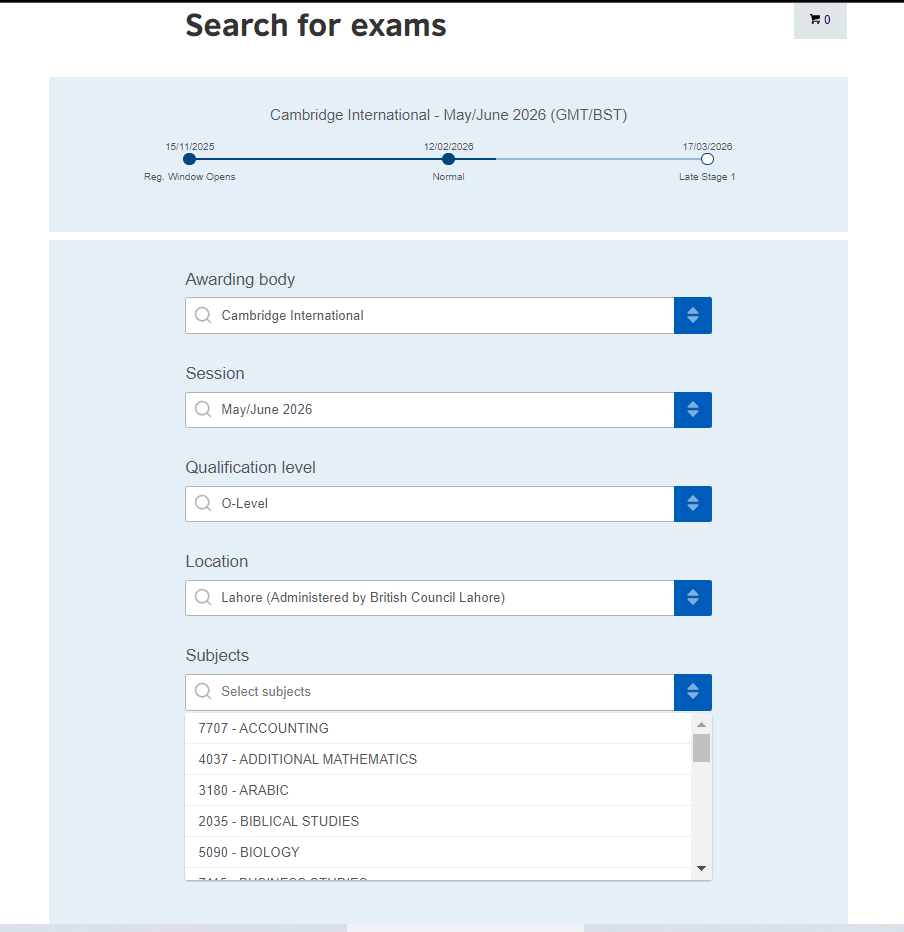
What to do on this screen:
Search for your Subjects: Click the "Select subjects" box. You will see a long list of options like Accounting, Biology, and Mathematics.
Match the Codes: Pay very close attention to the 4-digit code before the subject name (e.g., 7707 for Accounting or 5090 for Biology).
Why? Some subjects have very similar names but different syllabus codes. Always double-check your textbooks or syllabus to make sure the code matches exactly.
Add to List: Once you click a subject, it will be added to your registration basket. You can repeat this until all the exams you want to take are listed.
In the screenshot, you see just one subject selected as an example. However, it is vital that you search for and add every single subject you are studying for this session right now.
How to do it properly:
- Don't stop at one: After you click your first subject (like Accounting), the box will clear. Go back into the "Select subjects" dropdown and find your next one (like Mathematics or Physics).
- Review your "Basket": As you add subjects, you will see them list out. Double-check that you haven't missed anything.
- One Session, One Go: It is much easier to register for all 5 or 8 of your subjects at once rather than trying to come back and add more later, which can sometimes lead to technical glitches or extra processing times.
Important: Check the Registration Window
Look at that blue timeline at the top of the screenshot again. You can see the dates for "Normal" registration versus "Late Stage 1."
- Normal Window: In this example, it ends on 12/02/2026.
- Late Stage 1: Starts on 17/03/2026.
If you add your subjects after the "Normal" deadline, the cost per subject will go up significantly! It’s always best to get this done as early as possible.
Once you select a subject from the dropdown menu, it doesn't automatically save. You have to scroll down and review the specific details for that subject before officially adding it to your registration.
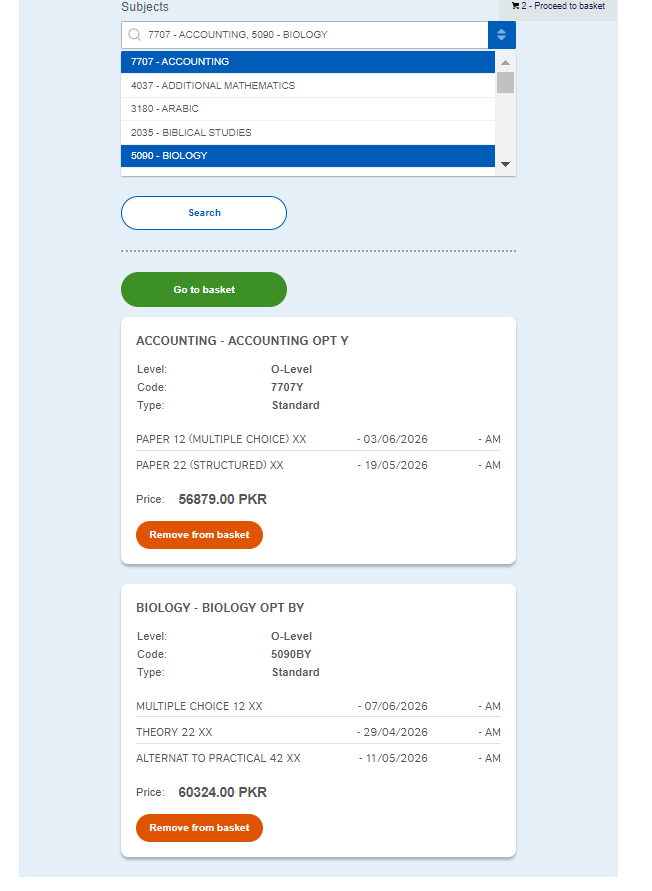
What to do on this screen
- Check the Price: You will see the total fee in PKR for that specific subject.
- The Final Selection: Look for the button that says "Add to basket" (or in this case, the green "Go to basket" button once you've finished adding).
- Managing Your List: If you accidentally pick the wrong code, don't panic! You can just hit the orange "Remove from basket" button and try again.
Important: Select Your Options
For some subjects, you might see different "Options" (like Option Y or Option BY). These usually refer to which specific combination of papers you are taking (like whether you are doing a Practical or an Alternative to Practical). Double-check your syllabus to make sure you are clicking the right one!
Step 10: Review Your Exam Basket
Before you pull out your credit card, the system gives you one last look at your "shopping cart." This is the most important time to slow down and verify every single detail.
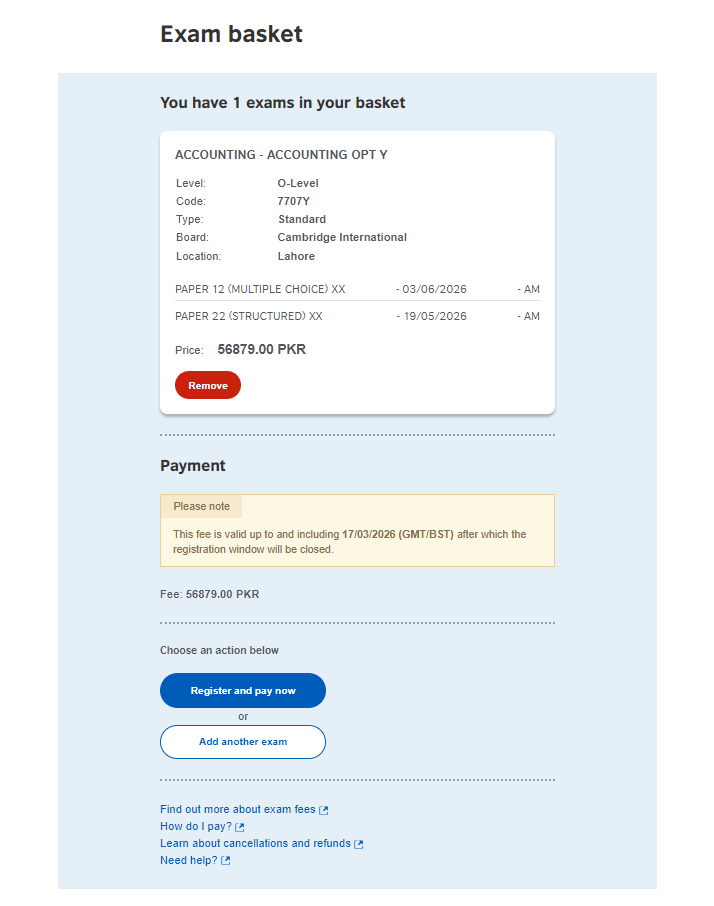
What to check on this screen:
- The Subject & Code: Make sure it says exactly what you intend to take .
- The Total Fee: You’ll see the fee in PKR. Notice the "Please note" box—it tells you exactly how long this price is valid. In this example, the fee is locked in until March 17, 2026. If you wait until after that date, the price will go up!
What are your options here?
- Add another exam: If you realized you forgot a subject (like Urdu or Physics), don't hit pay yet! Click the white "Add another exam" button to go back and search for more.
- Remove: If you accidentally added the wrong syllabus, hit the red "Remove" button and start that subject over.
- Register and pay now: If everything looks perfect and your total matches what you expected, click the big blue "Register and pay now" button to move to the final stage.
Step 11: Entering Candidate Details
Once you click "Register and pay now," you’ll be taken to the Candidate details form. This is where you provide your personal information for your official exam documents.
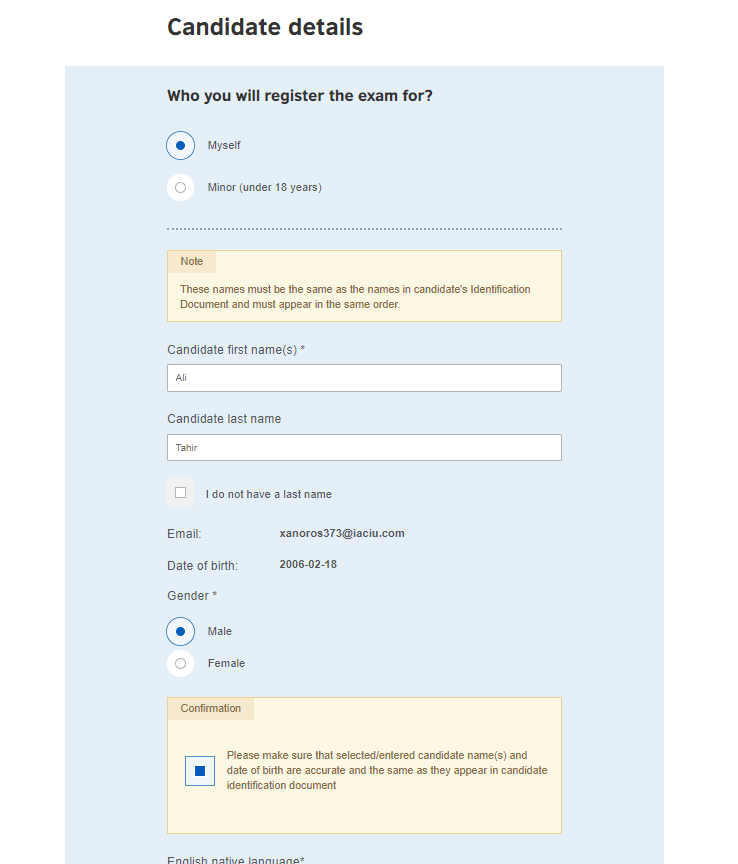
What to do on this screen:
- Who are you registering? Since you are doing this for yourself, select the "Myself" bubble.
- Legal Name Check: Enter your First Name and Last Name exactly as they appear on your ID (Passport or CNIC/B-Form).
- Crucial: Do not use nicknames! If your ID says "Muhammad Ali," don't just write "Ali."
- Confirm Information: Check the box that says you've verified your name and date of birth are accurate. This is your way of telling the British Council, "Yes, I've double-checked my ID!"
- Gender: Select your gender as it appears on your official documents.
Contact & Address Information
Scroll down to complete your profile. This information is used for mailing your certificate and contacting you if there’s an emergency with your exam venue.
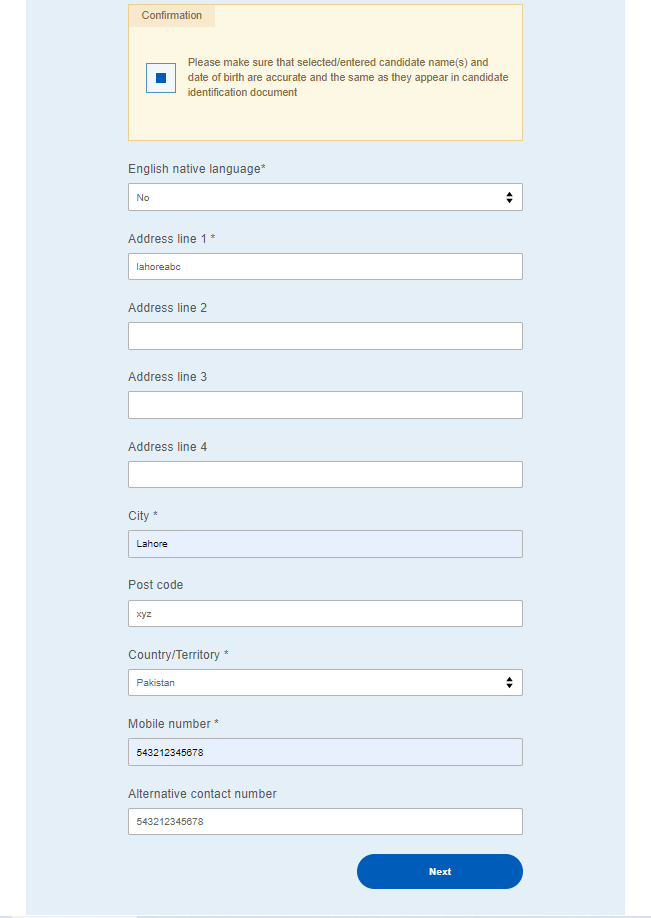
What to fill out here:
- English native language: Select "No" (unless English is actually your first language at home).
- Address: Provide your current home address. Make sure "Address Line 1" is clear, as this is where your physical results and certificates might be sent.
- City & Post Code: Enter your city (e.g., Lahore) and your local postal code. If you don't know your postal code, a quick Google search for your neighborhood will find it for you!
- Mobile Number: Enter a working mobile number. The British Council often sends SMS alerts for venue changes or result releases here.
- Alternative Number: It’s a great idea to put a parent’s or sibling's number here, just in case your phone is off.
Final Action: Once every box with a red asterisk (*) is filled, hit the blue Next button.
Step 11: Registering as a Minor (Under 18)
If you are a parent registering for your child, or a student under 18 using a parent's account, this is the section for you. The British Council has extra safety steps for minors, so the forms will ask for a bit more detail than the standard "Myself" registration
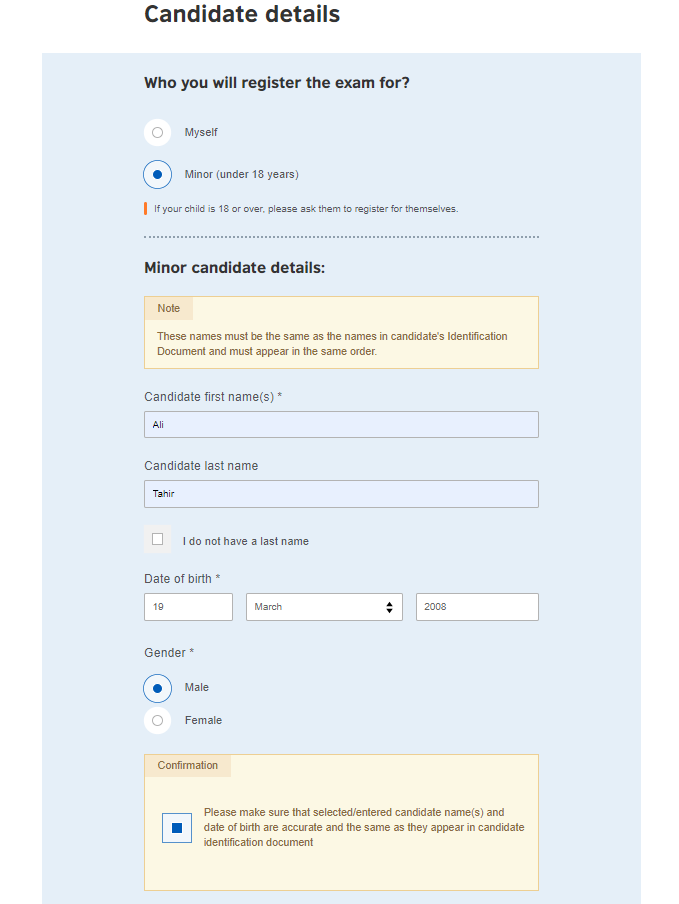
.What to do on this screen:
- Select "Minor (under 18 years)": Once you click this, the "Minor candidate details" section will open up.
- The Student’s Legal Name: Just like the adult version, enter the student’s First and Last Name exactly as they appear on their B-Form or Passport.
- Date of Birth: Enter the student's birthday. If the system calculates they are 18 or older, it will actually prompt them to go back and register "Myself."
- Confirm Details: Tick the blue confirmation box. This is your promise that the name and birthday match the official ID.
The next part of the minor registration is the contact info. Even if you live in the same house, this should be the primary address where you want the student's results mailed.
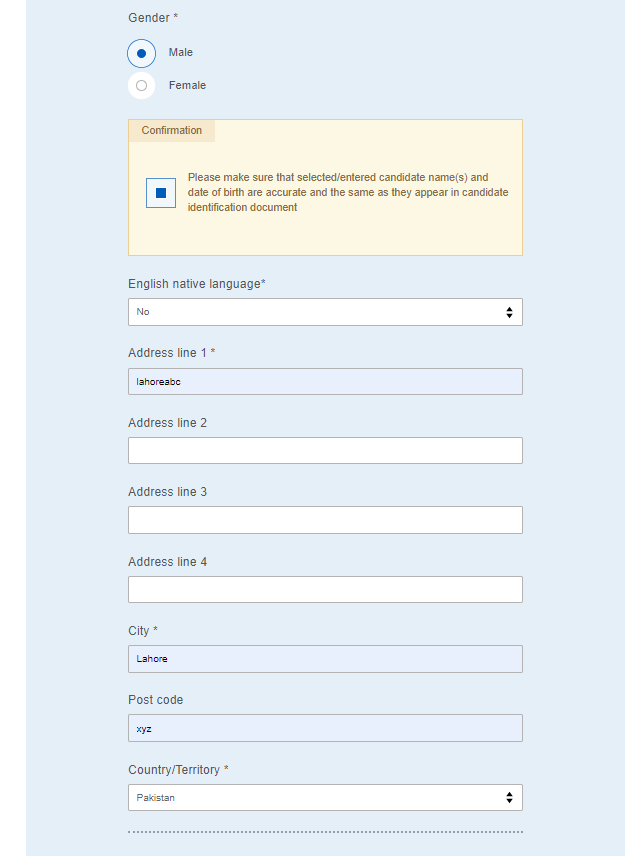
- Address & City: Fill in your street address and city (e.g., Lahore).
- Postal Code: Don't forget the post code!
Child Protection & Contact Details
Because the student is under 18, the British Council needs to know who is responsible for them and how they will get home after the exam.
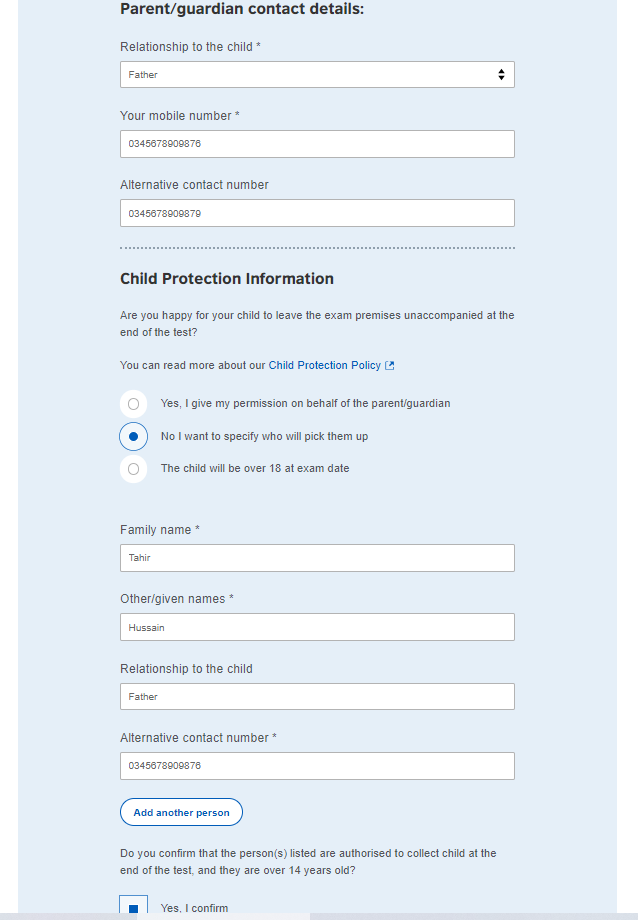
What to fill out here:
- Relationship to the child: Select whether you are the Father, Mother, or Legal Guardian.
- Mobile Numbers: Provide two different working numbers so the British Council can reach a parent instantly if needed.
- Child Protection Information: This is a big one! You have to decide if the student is allowed to leave the exam hall alone.
- Option 1: "Yes, I give my permission" (The student can walk out and go home on their own).
- Option 2: "No, I want to specify who will pick them up" (You’ll need to provide the name and ID of the person coming to get them).
- Authorization: Confirm that the person picking up the student is over 14 years old.
Step 12: Identity Verification
Now that your personal details are in, the system needs your official identification info. This is used to make sure the right person is sitting for the exam.
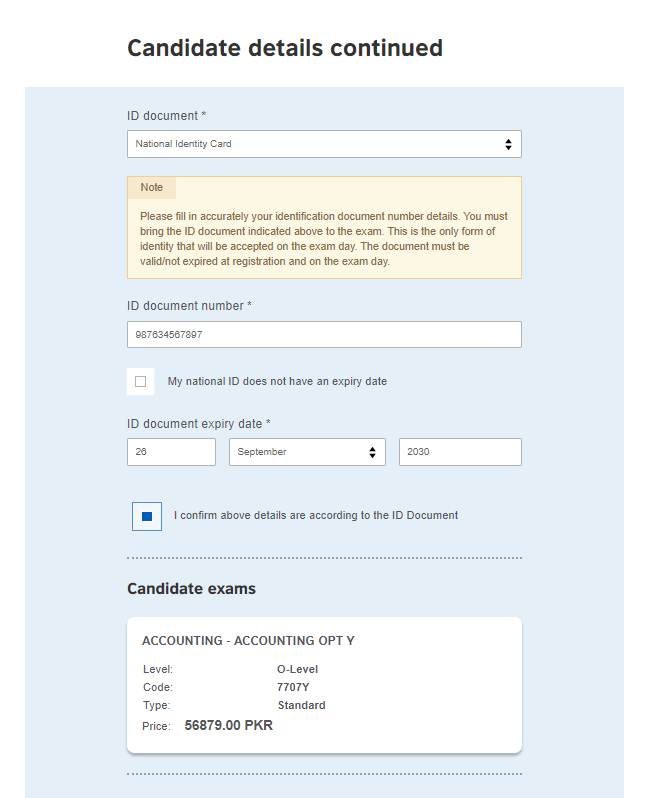
What to do on this screen:
- Select ID Document: Choose the type of ID you will be using. Most students in Pakistan use their National Identity Card (CNIC), Passport, or B-Form.
- Enter ID Number: Type in the number carefully. If you're using a CNIC, double-check every single digit.
- Expiry Date: Look at your ID card and enter the exact expiry date.
- Note: If your ID is a lifetime card with no expiry, there is a small checkbox that says "My national ID does not have an expiry date."
- The Confirmation Check: Tick the box to confirm that everything you’ve entered matches your physical document.
Reviewing Fees and Awards
If you scroll down, you’ll see a summary of your costs and some extra options called "Group Awards."
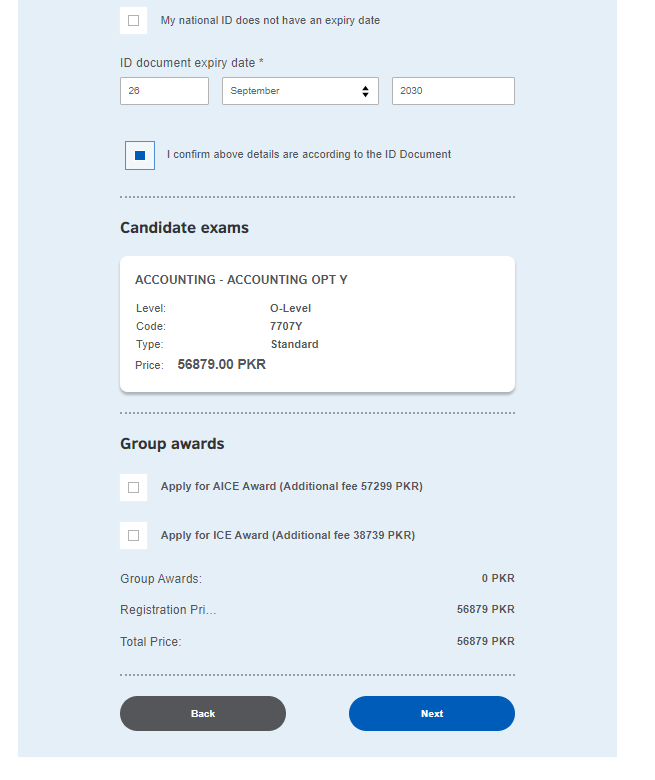
What you’re looking at:
- Candidate Exams: A final recap of the subjects you picked (like Accounting) and the price.
- Group Awards (AICE/ICE): You’ll see options to apply for the "AICE" or "ICE" awards.
- What are these? These are special certificates for students who take a specific group of subjects. Most private candidates leave these un-ticked unless they are specifically aiming for those awards, as they come with an extra fee.
- Total Price: This is the final amount you’ll be paying.
- Click Next: If the total looks right and you’ve verified your ID info, hit the blue Next button.
Step 13: Terms and Conditions
Before you can officially submit your application, you have to agree to the British Council’s rules. This page covers everything from how they handle your data to what happens if you miss an exam.
The Summary of what’s in there:
- Your Responsibility: You are confirming that you’ve picked the right subjects and codes. If you made a mistake, you'll likely have to pay a penalty fee to fix it later.
- ID Policy: You must bring the original ID (CNIC/Passport/B-Form) that you listed in Step 12 to every single exam. No ID means no entry no exceptions!
- Statement of Entry (SOE): They promise to email your SOE and venue details about two weeks before the exams start. if you don't get it by then, you need to contact them immediately.
- Refunds: Basically, once you pay, it’s very hard to get a refund unless there are extreme medical circumstances.
What to do:
- Read the Key Points: Pay special attention to the contact email info@britishcouncil.org.pk and their helpline number in case you need them later.
- The Final Checkbox: Scroll all the way to the bottom and tick the box that says "I have read the terms and conditions."
- Complete Registration: Click the big green "Complete registration" button.
Step 14: Choosing Your Payment Method
After you agree to the terms, you’ll reach the payment gateway. You need to decide whether you want to pay instantly online or manually through a bank.
Option A: Pay Online
If you have a Visa or Mastercard (Debit or Credit card), this is the easiest way.
- The Perk: Your registration is confirmed almost instantly.
- Keep in Mind: Since the British Council processes these transactions in foreign currency, your bank might charge a small exchange rate fee on top of the PKR amount shown.
Option B: Pay Offline (Bank Deposit/Transfer)
If you don't want to use a card, select "Pay another way." * Cash: You can visit any Standard Chartered Bank (SCB) or Muslim Commercial Bank (MCB) branch and deposit the cash using the British Council's specific deposit slip.
- Bank Transfer/ATM: You can use your banking app (IBFT) or an ATM to transfer the funds.
How to Pay via Bank Transfer/ATM (IBFT)
If you chose the "Offline" route, pay close attention to the instructions on the second half of the screen.
What to do:
- Find your Virtual Account Number: The system will give you a unique 16-digit Virtual Account Number (in the example, it starts with 5566...).
- CRITICAL: This number is unique to your registration. Never use a friend's number, or your payment won't be tracked to your account!
- The Transfer: * Select Standard Chartered Bank as the beneficiary.
- Enter your 16-digit Virtual Account Number.
- The beneficiary name should appear as "British Council."
- Confirm the Amount: Enter the exact fee (e.g., 56879.00 PKR) and hit send.
- Imp: If you pay offline, your status on the portal won't change to "Paid" immediately. It usually takes 2 to 3 working days for the bank to talk to the British Council and confirm your seat. Don't panic if it still says "Pending" right after you pay.
Once you’ve selected your method and noted down your payment details, click the blue Continue button to finish the session.
Step 15: Registration Confirmation & Summary
Once you’ve selected your payment method and clicked continue, you will land on the Registration Summary page. This is your official proof that your application has been submitted to the British Council.
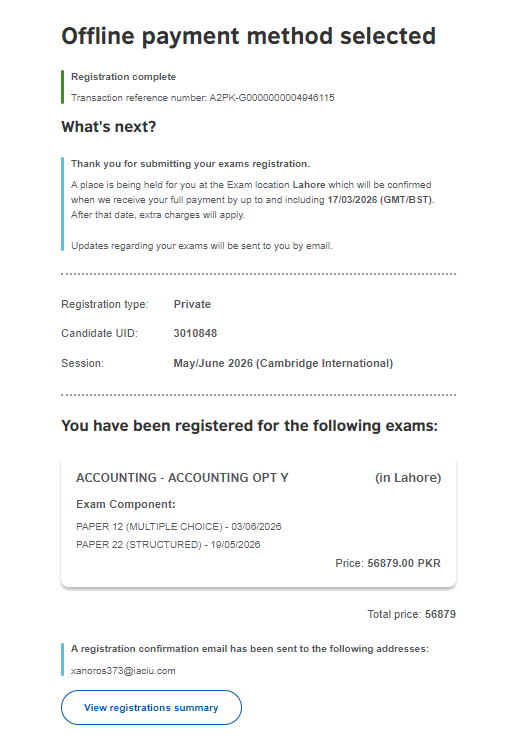
What to look for on this screen:
- Registration Status: * If you paid by card, this should say "Paid" or "Confirmed."
- If you chose bank transfer, it will likely say "Pending Payment." This is normal! It will stay "Pending" until the bank processes your funds (usually 2-3 working days).
- Registration Reference Number: You’ll see a unique code (usually starting with PK...). Write this down! You will need this number if you ever need to call the British Council or if you need to manually track your payment.
- The "Download Summary" Button: This is the most important part of this screen. Click the link to download your Registration Summary PDF.
- Why? This PDF contains your session details, your subject list, and your unique Virtual Account Number for payment. Keep a digital and a printed copy of this!
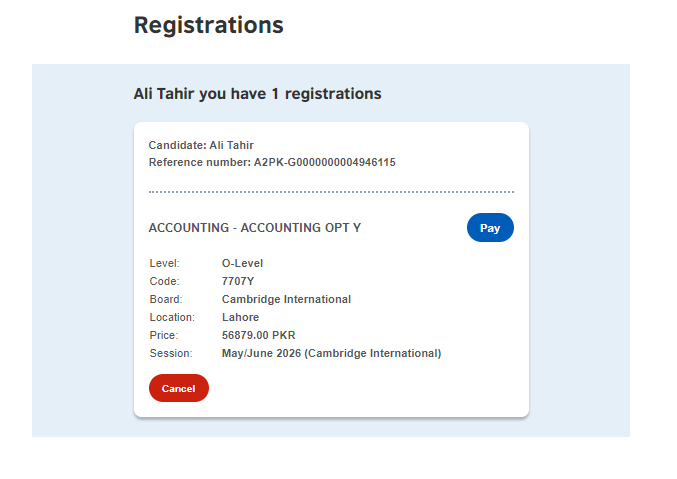
Now that the online part is done, here is the final "offline" checklist:
- Wait for the Email: You should receive an automated email from the British Council within a few minutes confirming they've received your registration.
- Keep your Receipts: If you paid via a bank or ATM, keep the stamped slip or a screenshot of the transfer. Do not throw these away until you get your Statement of Entry!
- The Statement of Entry (SOE): About 2-3 weeks before your first exam, the British Council will send your official SOE to your email. This will have your exact center location and your seat number.
Step 16: The Offline Payment Email
If you selected the "Pay Another Way" (Offline) option, check your inbox immediately. The British Council will send you an email titled "Offline Payment Method." > Important: This email does NOT mean you are registered yet. It means your "seat" is being held temporarily.
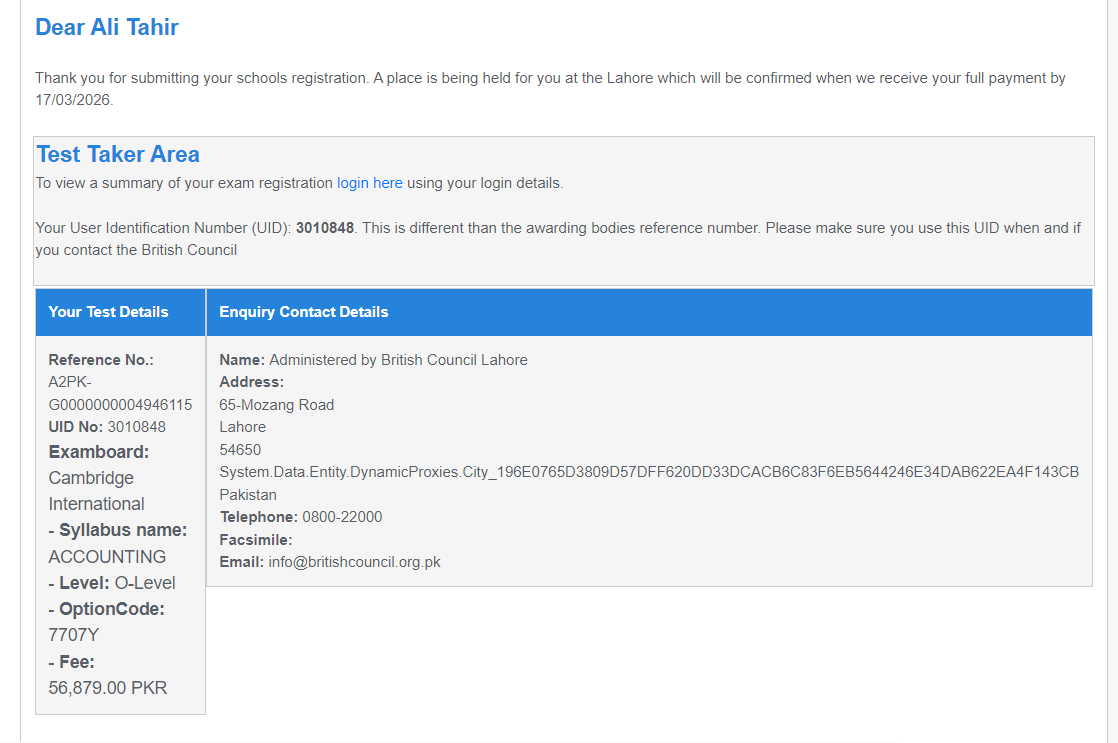
Key information inside this email
- The Deadline: The email will give you a specific date (usually 3 days from registration) by which you must pay. If you don't pay by this date, your application will be cancelled, and you'll have to start all over again!
- Your UID Number: You’ll see a User Identification Number (UID). This is your unique ID for this specific session. Keep it handy whenever you contact the British Council.
- Subject Recap: It will list all the exams you selected and the total fee in PKR.
- Payment Instructions: It will repeat your 16-digit Virtual Account Number and the instructions for IBFT or ATM transfers that we saw in Step 14.
What to do next:
- Print the Email: It’s always safer to have a hard copy.
- Make the Payment: Use the Virtual Account Number to pay via your banking app or at the bank.
- Save the Receipt: Once you pay, the bank will give you a transaction ID or a stamped slip. Do not lose this! It is your only proof of payment until the British Council updates your status to "Paid" on the portal.
- Imp: Give the system about 48 to 72 hours to update after you pay. The banks and the British Council systems aren't "live" with each other, so it takes a little time for the manual verification to happen.
Congratulations! You’ve successfully navigated the British Council registration process. It might feel like a lot of steps, but by following this guide, you’ve ensured that your details are correct and your seat is reserved.
What to do while you wait:
- Monitor your Inbox: Keep an eye on your email for the "Payment Confirmed" notification (if you paid offline) and your official Statement of Entry, which usually arrives a few weeks before exams start.
- Double-Check the Dates: Mark your exam dates on your calendar now so there are no surprises.
- Keep your ID Safe: Remember, the Passport or CNIC/B-Form you used for this registration is your "ticket" into the exam hall. Keep it in a safe place!
Need Help?
If you run into any technical glitches or have questions about your specific subjects, you can always reach out to the British Council Pakistan directly:
- Email: info@britishcouncil.org.pk
- Helpline: 0800-22000
Good luck with your studies! You’ve done the hard work of signing up now it’s time to focus on aceing those exams.